
In January 2015, a tense and extraordinary standoff unfolded inside a Texas hospital, raising enduring questions about medical certainty, parental instinct, and the limits of life-and-death decisions. At the center of the incident was George Pickering II, a father who refused to accept doctors’ declaration that his 27-year-old son was clinically brain-dead following a catastrophic stroke.
Physicians told Pickering that his son had suffered massive brain damage and showed no signs of recovery. After extensive evaluation, the medical team concluded that continued treatment was futile and scheduled the withdrawal of life support. To the hospital staff, the decision followed established medical standards. To the father standing at his son’s bedside, it felt final in a way he could not accept.
Believing his son was still alive and capable of recovery, Pickering took a desperate and dangerous step. He brought a handgun into the hospital, entered the intensive care unit, and barricaded himself inside his son’s room. The hospital was immediately locked down. Patients, families, and staff were secured in place as police surrounded the ward.
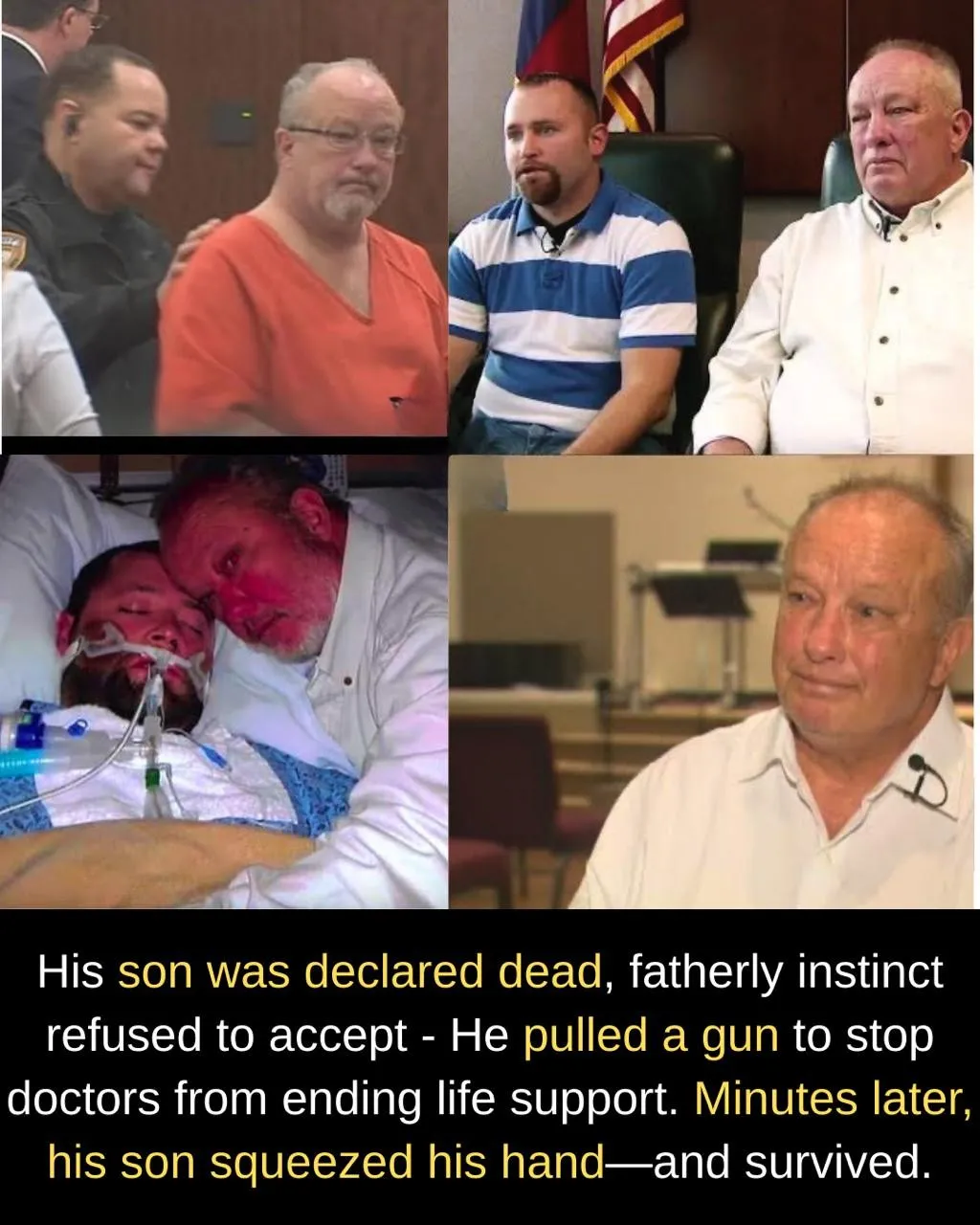
For approximately three hours, the situation remained at a stalemate. Negotiators attempted to de-escalate the crisis, urging Pickering to put down the weapon and allow doctors to proceed. Inside the ICU room, the father refused to leave. His demand was singular and unwavering: more time.
Hospital officials later emphasized that their priority was the safety of everyone in the building. Law enforcement treated the incident as an armed standoff, while medical staff waited anxiously, unable to continue treatment or formally withdraw life support amid the chaos.
Then, amid the tension, something unexpected occurred.
While officers were still stationed outside the room, Pickering’s son reportedly squeezed his father’s hand. Medical staff interpreted the movement as a clear, voluntary response—something that contradicted the earlier assessment of complete brain death. The withdrawal process was immediately halted, and treatment resumed.
The son survived.
In the weeks and months that followed, his condition improved. He regained consciousness, began to speak, and eventually was able to walk again. For many observers, the recovery appeared to validate the father’s belief that his son had not finished fighting.
Yet the outcome did not erase the gravity of Pickering’s actions.
George Pickering II was arrested and charged with aggravated assault for bringing a firearm into a hospital and threatening staff. Prosecutors acknowledged that no one was physically harmed during the incident and that Pickering never fired the weapon. Ultimately, he received a reduced sentence, reflecting both the seriousness of the offense and the extraordinary circumstances surrounding it.
The case sparked intense debate nationwide.
Medical professionals emphasized that declarations of brain death are not made lightly and are based on rigorous criteria designed to protect patients and families from prolonged suffering and false hope. Allowing armed coercion, they warned, could endanger lives and undermine trust in healthcare systems.
Others, however, saw the case as a troubling reminder that medical judgments, while evidence-based, are not infallible. Brain injury outcomes can be unpredictable, and rare recoveries—though uncommon—do occur. For some families, the Pickering case became a symbol of resistance against decisions perceived as premature or irreversible.
Ethicists noted that the situation was not a triumph of violence, but a collision of competing authorities. On one side stood medical expertise and legal protocol. On the other stood a parent’s refusal to surrender his child to a diagnosis he believed was wrong. The firearm did not create the recovery, but it did force time—and in this case, time proved decisive.
Hospitals across the country reviewed security protocols and reinforced policies to prevent similar incidents. Meanwhile, the case continued to circulate in public discourse, often stripped of nuance and reduced to stark headlines.
At its core, the story endures because it touches a deeply uncomfortable question: how final is a medical declaration when the human body has not yet stopped responding?
The Pickering case does not offer simple answers. It does not justify violence, nor does it dismiss medical expertise. Instead, it exposes the fragile space where certainty, hope, and fear intersect—where decisions must be made under immense pressure, and where the consequences can echo far beyond a single hospital room.
For one father and one son, that collision changed everything.


0 commentaires:
Enregistrer un commentaire